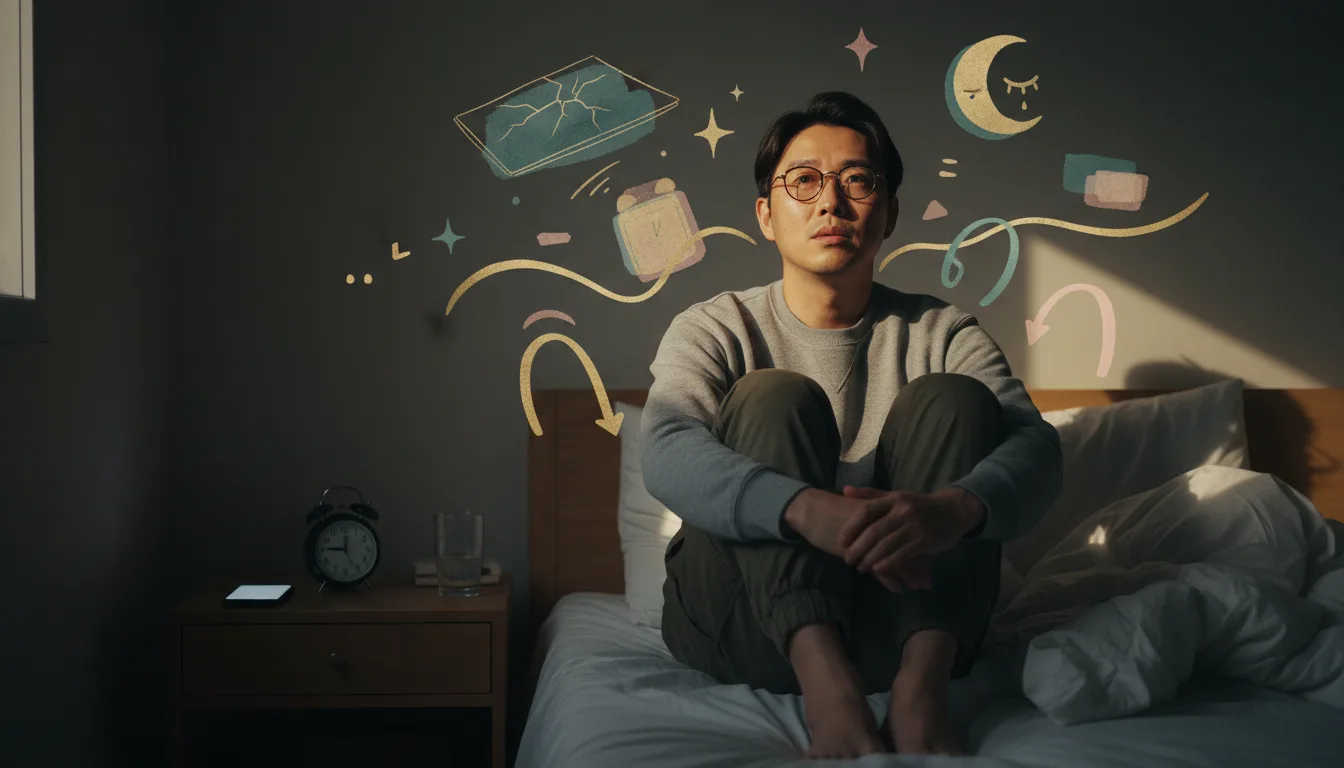
Why do adults with ADHD struggle with sleep?
Sleep problems in ADHD are not simply a matter of bad habits. Research points to biological differences in circadian timing, heightened mental arousal at night, and complex interactions with ADHD medications as core drivers. These factors often overlap, creating a pattern that generic sleep tips cannot address on their own.
A 2018 meta-analysis of subjective and objective sleep studies found that adults with ADHD differed significantly from controls on seven out of nine self-reported sleep measures, including longer time to fall asleep and lower sleep efficiency (Díaz-Román et al., 2018) [1]. The problems are not imaginary: actigraphic data (wrist-worn movement sensors) confirmed significantly longer sleep onset latency and reduced sleep efficiency compared to adults without ADHD.
A review of the relationship between ADHD and sleep proposed four overlapping pathways: ADHD may cause sleep problems as an intrinsic feature of the disorder; sleep problems may cause or mimic ADHD symptoms; the two may interact with reciprocal causation; or they may share a common underlying neurology (Hvolby, 2015) [2]. In practice, most adults experience some combination of all four.
This means that if you have been struggling with sleep for years and standard advice like "put your phone away" has not worked, there may be a biological reason. Understanding the specific mechanisms can help you and your clinician choose strategies that actually match the problem.
If you are noticing symptoms of ADHD in your daily life, sleep disruption is worth paying attention to. It is both a common consequence of ADHD and a factor that can make every other symptom worse.
How does the ADHD circadian rhythm differ?
 A delayed circadian clock means the ADHD brain often does not produce melatonin until well after midnight.
Adults with ADHD tend to have a delayed circadian rhythm, meaning their internal body clock runs later than the typical schedule. This shows up as difficulty falling asleep at a conventional bedtime, trouble waking in the morning, and a strong preference for evening activity. Research suggests this pattern resembles delayed sleep phase disorder.
A systematic review of circadian rhythmicity in adult ADHD found that dim light melatonin onset (DLMO), the biological marker for when the body begins preparing for sleep, is delayed in adults with ADHD compared to controls (Snitselaar et al., 2017) [3]. The review also found that adult ADHD is associated with increased eveningness and later waking times.
"Adult ADHD is associated with delayed circadian rhythmicity and analogous sleep characteristics, which are typical of a delayed sleep phase disorder."
Snitselaar et al., 2017 [3]
This is not laziness or poor discipline. The circadian system is regulated by genetics and neurotransmitter activity, and the same dopamine pathways involved in attention regulation also play a role in sleep-wake timing. When your body is not producing melatonin until later than average, willpower alone cannot force sleep to arrive on schedule.
The practical consequence is familiar to many adults with ADHD: lying in bed fully alert at 11 p.m. while knowing the alarm is set for 6:30 a.m. Over time, this mismatch between biological readiness and social obligations (sometimes called "social jetlag") accumulates into chronic sleep debt.
Circadian rhythm differences also help explain why some adults with ADHD feel most productive and focused late at night. That late-night clarity is not a quirk; it may reflect the brain reaching its peak alertness window hours after the conventional workday has ended.
Why do racing thoughts get worse at bedtime?
Many adults with ADHD describe a surge of mental activity the moment they lie down. Thoughts accelerate, jump between topics, and resist deliberate quieting. This pattern often arises from the same attention-regulation difficulties that define ADHD during the day, though it can overlap with anxiety and the two can be difficult to separate without a broader clinical picture.
During the day, external demands and stimulation help direct attention outward. At bedtime, when external input drops away, the brain's internal mental activity may become more noticeable. Research suggests that the neural systems involved in internally directed thought can remain more active in people with ADHD, making the transition from wakefulness to sleep particularly difficult (Um et al., 2017).
A 2024 study on insomnia in adults with ADHD found that sleep reactivity (the tendency to develop insomnia in response to stress) was significantly higher in adults with ADHD compared to healthy controls (Uygur et al., 2024). Higher ADHD symptom severity and being female both predicted worse insomnia. This suggests that the ADHD brain may be more vulnerable to the kind of stress-triggered wakefulness that turns a bad night into a chronic pattern.
The frustration compounds: lying awake generates its own anxiety about not sleeping, which further activates the mind. Many adults with ADHD develop a conditioned alertness response to their own bed, where the bedroom becomes associated with wakefulness rather than rest.
It is worth noting that racing thoughts at bedtime are not always anxiety, though the two frequently coexist. Anxiety-driven rumination tends to circle around specific worries (health, finances, social situations), while ADHD-related mental activity often jumps unpredictably between unrelated topics, plans, memories, and creative ideas. A clinician familiar with both conditions can help distinguish the pattern, which matters because the most effective treatment may differ.
If you are wondering whether attention difficulties might be contributing to your sleep problems, tracking the content of your bedtime thoughts for a week, worry-focused versus unrelated topic-jumping, gives a clinician useful signal for sorting ADHD from anxiety.
How do ADHD medications affect sleep?
Stimulant medications can either help or hinder sleep depending on timing, formulation, and individual response. Some adults find that treated ADHD symptoms allow their mind to quiet at bedtime, while others experience medication-related insomnia as a direct side effect.
The relationship is genuinely complex. Hvolby's 2015 review noted that psychostimulant medications are associated with disrupted sleep but also "paradoxically" calm some patients with ADHD for sleep by alleviating their symptoms (Hvolby, 2015) [2]. Long-acting formulations may have insufficient duration of action, leading to symptom rebound at bedtime, which can cause a surge of restlessness and racing thoughts as the medication wears off.
Snitselaar et al. (2017) found that stimulant treatment can induce further delay of circadian parameters (Snitselaar et al., 2017) [3]. This means that for some people, the medication that helps during the day may push their body clock even later at night.
Practical considerations for medication timing
Every medication response is individual. What disrupts sleep for one person may improve it for another. The most important step is tracking your sleep pattern (with and without medication) and sharing that data with your prescribing clinician. For a broader overview of how different ADHD medications work, see our ADHD medications guide.
What evidence-based strategies actually help ADHD sleep problems?
 Standard relaxation techniques often fall short for ADHD because the brain resists low-stimulation activities at bedtime.
The most effective approach for ADHD-related sleep problems usually combines circadian interventions (light and timing), cognitive-behavioral techniques, and lifestyle adjustments. Generic sleep hygiene advice is a starting point, but adults with ADHD often need strategies that specifically address delayed circadian timing and high mental arousal.
Morning bright light therapy
A 2021 literature review from Massachusetts General Hospital and Harvard Medical School identified morning light therapy as having the strongest preliminary evidence for improving sleep in adults with ADHD. Three of six systematic prospective studies found a significant effect of morning light therapy on shifting circadian timing toward morningness, which was also associated with reduced ADHD symptoms (Surman & Walsh, 2021) [4].
"Low-risk interventions such as light therapy may improve sleep in adults with ADHD, but many sleep interventions currently in use remain unstudied in the ADHD population."
Surman & Walsh, 2021 [4]
The principle is straightforward: bright light exposure in the first 30 to 60 minutes after waking helps reset the circadian clock earlier. A 10,000-lux light box used for 20 to 30 minutes each morning is the most studied approach. Natural sunlight works too, particularly in spring and summer.
CBT-I (cognitive behavioral therapy for insomnia)
CBT-I is considered the first-line treatment for chronic insomnia by most clinical guidelines, and preliminary evidence supports its use in adults with ADHD (Surman & Walsh, 2021). CBT-I typically includes:
- Sleep restriction: Temporarily limiting time in bed to match actual sleep time, then gradually extending it
- Stimulus control: Using the bed only for sleep (and intimacy), getting up if awake for more than 15 to 20 minutes
- Cognitive restructuring: Addressing unhelpful beliefs about sleep ("I'll never function tomorrow if I don't fall asleep right now")
- Relaxation training: Structured techniques to reduce physical and mental arousal before bed
For adults with ADHD, CBT-I may need adaptation. Executive function difficulties can make it harder to follow rigid sleep schedules, and the initial sleep restriction phase can temporarily worsen daytime ADHD symptoms. Working with a therapist who understands ADHD can help adjust the protocol.
Physical activity
A 2023 cross-sectional study using NHANES data found that adults with ADHD on stimulant medications who met the US guideline of 150 minutes per week of moderate-to-vigorous physical activity had a significantly lower risk of reporting trouble sleeping (OR: 0.26) (Zhu et al., 2023). The association was stronger in men than women, and the study authors noted that gender differences warrant further investigation.
Timing matters: vigorous exercise within two to three hours of bedtime can increase arousal for some people. Morning or afternoon activity is generally a safer bet for sleep.
ADHD-specific sleep checklist
Use this checklist to identify which strategies to discuss with your clinician:
Many adults with ADHD also find that caffeine habits play a larger role in sleep quality than they expect. Caffeine's half-life is roughly five to six hours, meaning an afternoon coffee can still be active in your system at bedtime.
What about weighted blankets and melatonin?
The Surman & Walsh (2021) review found preliminary evidence for both weighted blankets and melatonin in adults with ADHD, though the evidence base is small (Surman & Walsh, 2021). Weighted blankets may help reduce physical restlessness. Melatonin, when used to shift circadian timing rather than as a sedative, should be discussed with a clinician who can advise on appropriate use and timing.
When should you see a sleep specialist?
If sleep problems persist after several weeks of consistent behavioral strategies and medication timing adjustments, a referral to a sleep specialist can help identify whether a separate sleep disorder is contributing. Adults with ADHD have higher rates of obstructive sleep apnea, restless legs syndrome, and periodic limb movement disorder.
Hvolby's 2015 review emphasized that ADHD is frequently coincident with diagnosable sleep disorders, including obstructive sleep apnea, periodic limb movement disorder, restless legs syndrome, and circadian-rhythm sleep disorders (Hvolby, 2015) [2]. These conditions require their own treatment and can mimic or worsen ADHD symptoms.
Questions to ask a sleep specialist
Gregory et al. (2017) found that the overlap between ADHD and sleep problems in young adulthood was explained by genetic factors (55%) and nonshared environmental influences (45%) (Gregory et al., 2017). This suggests that for many people, sleep problems and ADHD share biological roots, making integrated treatment of both conditions especially important.
A sleep specialist can also help distinguish between ADHD-related sleep difficulties and primary sleep disorders. This distinction matters because treating an underlying sleep disorder sometimes improves ADHD symptoms substantially, while leaving it untreated can make ADHD management much harder.
If you have not yet explored whether ADHD might be contributing to your sleep difficulties, our free adult ADHD self-screener covers attention, restlessness, and bedtime mental arousal in one structured pass, useful evidence to bring to your GP or sleep specialist.
 Infographic: key points about adhd and sleep.
Generic sleep hygiene often misses the circadian and arousal differences unique to ADHD.
Infographic: key points about adhd and sleep.
Generic sleep hygiene often misses the circadian and arousal differences unique to ADHD.
Frequently asked questions
How common are sleep problems in adults with ADHD?
Sleep difficulties affect the majority of adults with ADHD. Estimates suggest that up to 80% experience significant sleep problems, including difficulty falling asleep, staying asleep, and waking in the morning (Hvolby, 2015). A meta-analysis confirmed that adults with ADHD report worse sleep across nearly all subjective measures compared to those without ADHD (Díaz-Román et al., 2018).
Is ADHD insomnia different from regular insomnia?
ADHD-related insomnia often involves a delayed circadian rhythm and difficulty "switching off" mental activity, rather than the stress-triggered pattern more typical of primary insomnia. That said, the two can overlap substantially. A 2024 study found that adults with ADHD also have higher sleep reactivity (vulnerability to stress-related insomnia), meaning both mechanisms may be at work (Uygur et al., 2024).
Can ADHD medication cause insomnia?
Stimulant medications can cause insomnia in some people, particularly if taken too late in the day or if the formulation wears off abruptly at bedtime. However, some adults find that medication actually improves sleep by reducing racing thoughts and restlessness. The effect is highly individual, and medication timing adjustments often help (Hvolby, 2015).
What is the best time to take ADHD medication to avoid sleep problems?
There is no single best time because it depends on the medication type, formulation, and your individual response. As a general principle, stimulants taken earlier in the day are less likely to interfere with sleep. Discuss timing with your prescriber, and consider keeping a two-week sleep log to identify patterns.
Does melatonin help with ADHD sleep problems?
Preliminary evidence suggests melatonin may help shift circadian timing in adults with ADHD when used appropriately (Surman & Walsh, 2021). It works best as a circadian signal (taken at a specific time to shift the body clock) rather than as a sedative. Discuss use and timing with your clinician, as the approach differs from over-the-counter use for occasional sleeplessness.
Does exercise help adults with ADHD sleep better?
Research suggests it can. A 2023 study found that adults with ADHD on stimulant medications who met physical activity guidelines had significantly lower odds of reporting sleep trouble (Zhu et al., 2023). The benefit appeared stronger in men, and the authors noted that gender differences need further study. Finishing exercise at least two to three hours before bedtime is generally recommended.
Are racing thoughts at night a sign of ADHD or anxiety?
They can be either or both. ADHD-related mental activity at bedtime tends to jump unpredictably between unrelated topics, while anxiety-driven rumination often circles around specific worries. The two frequently coexist, and a clinician familiar with both conditions can help distinguish the pattern. If you are unsure, tracking the content and pattern of your nighttime thoughts can provide useful information for a clinical conversation.
Can poor sleep make ADHD symptoms worse?
Yes. Sleep deprivation impairs attention, working memory, and impulse control in everyone, and these are the same functions already affected by ADHD. Gregory et al. (2017) found that the association between ADHD and poor sleep quality involves shared genetic factors, suggesting the two conditions can reinforce each other (Gregory et al., 2017).
What is CBT-I and does it work for ADHD?
CBT-I (cognitive behavioral therapy for insomnia) is a structured program that addresses the thoughts and behaviors maintaining insomnia. It typically includes sleep restriction, stimulus control, and cognitive restructuring. Preliminary evidence supports its use in adults with ADHD, though it may need adaptation for executive function challenges (Surman & Walsh, 2021).
Should I see a sleep specialist or my ADHD clinician first?
Start with whoever you already see. Your ADHD clinician can assess whether medication timing or ADHD symptoms are driving the problem and can refer you to a sleep specialist if needed. A sleep specialist is particularly valuable if you suspect sleep apnea, restless legs, or if behavioral strategies have not helped after consistent effort.
Does the ADHD circadian delay get better with age?
Research on this specific question is limited. Circadian preferences do tend to shift earlier with age in the general population, but whether this fully corrects the ADHD-related delay is unclear. Behavioral and light-based interventions remain the most practical approach regardless of age.
Can treating a sleep disorder improve ADHD symptoms?
It can in some cases. Because sleep deprivation mimics and worsens ADHD symptoms, treating an underlying sleep disorder (like sleep apnea or restless legs syndrome) sometimes leads to noticeable improvement in daytime attention and functioning (Hvolby, 2015). This is one reason clinical guidelines recommend assessing sleep problems during any ADHD evaluation.