What counts as a late ADHD diagnosis?
A late diagnosis refers to any ADHD identification that happens in adulthood, typically after age 18, even though symptoms were present in childhood. ADHD is classified as a developmental condition, meaning symptoms must have started before age 12, but the diagnosis itself can come much later. Many adults are identified in their 30s, 40s, or beyond.
The term "late" is relative. For the person receiving it, the diagnosis is not late at all. It arrives exactly when someone finally has access to the right clinician, the right information, or the right set of circumstances that makes the pattern visible. What makes it "late" is the gap between when symptoms began causing problems and when those problems were correctly named.
CDC data from 2023 found that more than half of adults with ADHD were diagnosed in adulthood [1]. This number has been rising, partly because awareness has increased and partly because telehealth expanded access to assessment during and after the COVID-19 pandemic. The NHS in the UK has also reported growing demand for adult ADHD assessments, with significant waiting lists in many regions [3].
If you are wondering whether your own experiences might fit the pattern, learning more about ADHD diagnosis in adults can help you prepare for a conversation with a clinician.
Why does ADHD go undiagnosed for so long?
ADHD often goes undiagnosed in adults because early screening tools and referral patterns were designed around hyperactive boys in school settings. People whose symptoms are primarily inattentive, who develop strong compensatory strategies, or who belong to groups that clinicians are less likely to screen can go decades without identification.
Several factors contribute to the delay:
Gender bias in recognition. A systematic review of ADHD in adult women found that women are more likely to present with inattentive symptoms, which are less disruptive in classrooms and therefore less likely to trigger a referral (Attoe et al., 2023) [6]. Women are also more likely to receive initial diagnoses of anxiety or depression instead. You can read more about this pattern in our article on ADHD in women.
Masking and compensation. Many adults, particularly women and people socialized to prioritize others' comfort, develop elaborate systems to hide their difficulties. High intelligence, strong social skills, or a supportive environment can mask ADHD symptoms for years. The effort required to maintain these systems often goes unrecognized. Our guide to ADHD masking explores how this works and what it costs.
Racial and ethnic disparities. Research consistently shows that Black, Latino, and other minority children are less likely to be referred for ADHD evaluation, and this gap carries into adulthood. Clinician bias, cultural differences in how symptoms are described, and unequal access to mental healthcare all play a role.
Comorbidity confusion. ADHD frequently co-occurs with anxiety, depression, and substance use problems. A mixed-method systematic review found that undiagnosed ADHD is linked to higher rates of depression, substance misuse, and lower educational attainment (French et al., 2023) [5]. When a clinician treats only the comorbid condition, the underlying ADHD can remain hidden for years.
The "you're doing fine" problem. Adults who hold jobs, maintain relationships, or earn degrees are sometimes told they cannot have ADHD. But functioning in one area does not rule out significant struggle in others. NIMH notes that ADHD symptoms must cause problems in at least two areas of life, not every area [2].
What does the emotional impact of a late diagnosis feel like?
A late ADHD diagnosis typically triggers a complex mix of relief, grief, anger, and confusion, sometimes all within the same day. A qualitative meta-synthesis of adults diagnosed in adulthood identified two overarching themes: ADHD as an identity shift and ADHD as a diagnosis that is simultaneously a revelation and a burden (Long et al., 2022) [4].
Relief is often the first response. There is a name for the pattern. You are not lazy, careless, or broken. The struggles that never made sense suddenly have an explanation rooted in neurology rather than character.
But relief rarely arrives alone. Many adults describe a wave of anger: at the teachers who called them unmotivated, at the clinicians who diagnosed anxiety but never asked about attention, at the systems that should have caught this sooner. This anger is legitimate. It reflects real losses.
"Overall, this study showed that delayed diagnosis of ADHD causes suffering and dysfunction that could be mitigated through earlier diagnosis and treatment."
Long et al., 2022 [4]
Some people feel a disorienting shift in identity. If you spent 35 years believing you were simply bad at time management, learning that your brain processes time differently changes how you see yourself. That change is not always comfortable, even when it is ultimately helpful.
Common emotional responses after diagnosis
How do you grieve what a late diagnosis cost you?
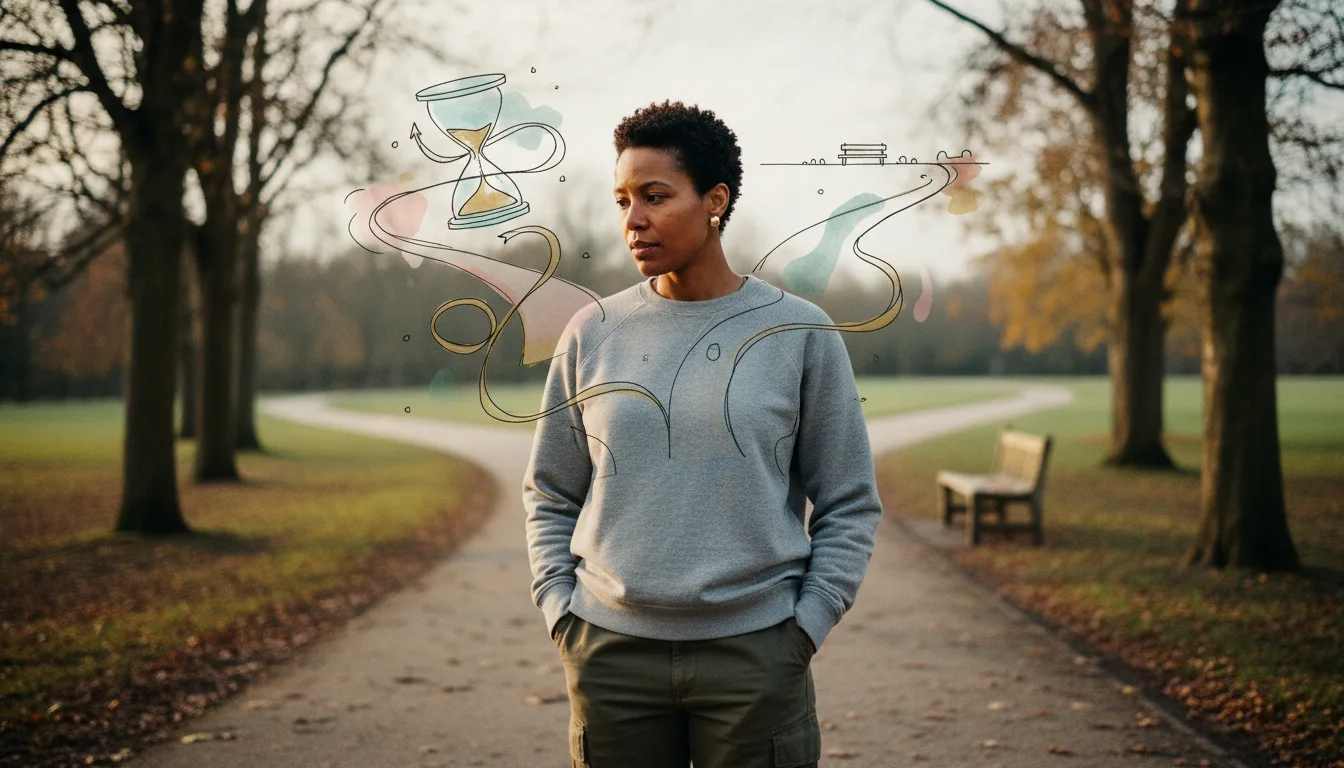
 Grief after a late ADHD diagnosis often centers on lost time and the effort spent masking difficulties.
Grieving a late ADHD diagnosis means acknowledging real losses, including career paths not taken, relationships strained by misunderstanding, and years of self-blame, without getting stuck in regret. There is no single right way to do this, and the process is rarely linear.
The grief is specific. It is not abstract sadness. It is remembering the job you lost because you could not meet deadlines. It is thinking about the friendships that faded because you forgot to reply. It is recalling the shame of report cards that said "not working to potential" when you were working as hard as you could.
Some practical approaches that many late-diagnosed adults find helpful:
- Name the losses concretely. Vague grief is harder to process than specific grief. Writing down what you wish had been different can make the feelings more manageable.
- Set a time boundary for looking back. Some people find it useful to dedicate a specific period (a journaling session, a therapy appointment) to processing the past, rather than letting it seep into every moment.
- Talk to someone who understands. A therapist familiar with adult ADHD can help you separate productive grief from rumination. Not every therapist has this expertise, so it is worth asking directly.
- Allow the grief to coexist with relief. You do not have to choose one feeling. Both can be true at the same time.
Research on adults with late-onset ADHD found that even those with milder symptom profiles experienced significant functional impairment and were more likely to have delayed diagnosis (Karam et al., 2009) [7]. The delay itself compounds the difficulty, because years without support create secondary problems (low self-esteem, relationship patterns, career instability) that take their own time to address.
If you are in the early stages of wondering whether ADHD might explain your experiences, writing a timeline of when specific difficulties began can make the first conversation with a clinician far more productive than a general description.
How do you reframe your life story after diagnosis?
Reframing after a late ADHD diagnosis means looking at your history through a new lens, not to excuse everything, but to understand it more accurately. The goal is context, not absolution. Many adults find that reframing reduces self-blame and opens space for more effective problem-solving.
This is not about deciding that ADHD explains every difficulty you have ever had. It is about recognizing where ADHD was a factor and where it was not. Some useful reframing questions:
- "Was I actually unmotivated, or was I struggling with executive function?"
- "Did I choose to procrastinate, or was task initiation genuinely harder for me?"
- "Was I being careless, or was my working memory making it difficult to track details?"
The systematic review by Attoe et al. (2023) found that women who received a late ADHD diagnosis described a shift toward self-acceptance as a key outcome, though this process took time and was not automatic [6]. Self-compassion research more broadly suggests that treating yourself with the same understanding you would offer a friend can reduce the intensity of shame.
Reframing checklist: questions to ask yourself
Reframing is not a one-time event. It tends to happen in layers, as new situations trigger old memories and you see them differently. A therapist experienced with ADHD can be particularly helpful during this process.
Can treatment still help after a late diagnosis?
Treatment for ADHD can improve daily functioning at any age. The brain's response to medication does not depend on when the diagnosis was made, and behavioral strategies can be learned at any point in life. A case report on a 49-year-old patient diagnosed with ADHD found improvements in anxiety regulation, concentration, and sleep quality after treatment began, though some cognitive challenges persisted (da Silva Leandro et al., 2024) [8].
Treatment for adults typically involves some combination of:
Medication. Stimulant and non-stimulant medications are the most-studied pharmacological treatments for ADHD. Individual responses vary, and finding the right medication and dose often requires adjustment over time. This should always be managed by a prescribing clinician. NIMH notes that medication can help manage symptoms but works best as part of a broader approach [2].
Therapy and coaching. Cognitive-behavioral therapy adapted for ADHD focuses on practical skills: time management, organization, emotional regulation, and breaking tasks into smaller steps. ADHD coaching is a separate service that focuses on accountability and strategy rather than mental health treatment.
Environmental changes. External supports (timers, visual reminders, simplified routines, body doubling) can reduce the demand on executive function. Many late-diagnosed adults have already developed some of these strategies intuitively; a diagnosis can help refine them.
Treating co-occurring conditions. Because ADHD often co-occurs with anxiety, depression, or sleep problems, treatment may need to address multiple conditions. The NHS recommends that clinicians consider co-occurring conditions as part of the assessment and treatment plan [3].
CDC data also notes that about one-third of adults with ADHD are not receiving any type of treatment [1]. If you have been diagnosed but are not yet receiving support, it is worth revisiting your options with a clinician.
How does connecting with other late-diagnosed adults help?
 External reminder systems like visible sticky notes are a practical first step many adults adopt after diagnosis.
Connecting with other adults who were diagnosed later in life can reduce isolation, normalize the emotional adjustment, and provide practical strategies from people who understand the experience firsthand. Community does not replace clinical treatment, but it fills a gap that treatment alone often cannot.
Late-diagnosed adults frequently describe feeling like they are the only person who has gone through this particular combination of relief, grief, and identity shift. Finding others who share that experience can be powerful.
Options for connection include:
- Online communities. Reddit forums (r/ADHD, r/adhdwomen), Facebook groups, and Discord servers dedicated to adult ADHD provide accessible, low-barrier entry points. The quality varies, so look for groups with active moderation and a focus on support rather than self-diagnosis.
- Local support groups. Organizations like CHADD (US) and ADHD Foundation (UK) offer in-person and virtual support groups specifically for adults.
- Peer coaching and accountability partners. Some adults find it helpful to pair up with another person with ADHD for regular check-ins on goals and strategies.
- Therapy groups. Group therapy led by a clinician familiar with ADHD can combine professional guidance with peer support.
A word of caution: online ADHD communities can sometimes reinforce an identity that centers entirely on the diagnosis. ADHD is one part of who you are. The most helpful communities tend to balance validation with forward movement.
If you are still in the early stages of exploring whether ADHD might be part of your picture, our adult ADHD self-screener for late-diagnosed readers walks you through the symptom areas clinicians check first, so you arrive at the appointment with organised notes instead of a vague hunch.
 Infographic: key points about late diagnosis adhd.
The emotional path after diagnosis is not linear; most adults move back and forth between stages.
Infographic: key points about late diagnosis adhd.
The emotional path after diagnosis is not linear; most adults move back and forth between stages.
Frequently asked questions
What age is considered a "late" ADHD diagnosis?
Any diagnosis after age 18 is generally considered late, since ADHD is a developmental condition with childhood onset. In practice, many adults are diagnosed in their 30s, 40s, or later. The CDC reports that more than half of US adults with ADHD received their diagnosis in adulthood [1].
Why are more adults being diagnosed with ADHD now?
Several factors are driving the increase: greater public awareness, expanded telehealth access during and after the COVID-19 pandemic, and improved recognition that ADHD presents differently in adults than in children. CDC data from 2023 highlights the growing role of telehealth in adult ADHD care [1].
Is a late ADHD diagnosis valid if I did well in school?
Yes. Academic success does not rule out ADHD. Many adults compensated through intelligence, extra effort, or supportive environments. NIMH notes that ADHD must cause impairment in at least two life areas, but those areas do not have to include academics [2].
Can grief after a late ADHD diagnosis feel like depression?
It can. The sadness, regret, and fatigue that accompany grief after diagnosis can resemble depressive symptoms. If these feelings persist or intensify, it is worth discussing them with a clinician who can distinguish between grief, depression, and ADHD-related emotional dysregulation.
Should I tell my family about my late diagnosis?
This is a personal decision. Some adults find that sharing their diagnosis helps family members understand past conflicts and current needs. Others prefer to process the diagnosis privately first. There is no obligation to disclose, and timing matters.
Will medication still work if I am diagnosed in my 40s or 50s?
Medication response does not depend on the age of diagnosis. Stimulant and non-stimulant medications can be effective for adults at any age, though individual responses vary and medical history (cardiovascular health, other medications) must be considered. A prescribing clinician can help determine what is appropriate.
How long does the emotional adjustment take after a late diagnosis?
There is no fixed timeline. Some adults feel a sense of clarity within weeks; others process grief and identity shifts over months or years. The qualitative meta-synthesis by Long et al. (2022) found that the adjustment involves ongoing identity renegotiation, not a single moment of resolution [4].
Are women diagnosed later than men on average?
Research consistently shows that women are diagnosed later. A systematic review found that women with ADHD are more likely to present with inattentive symptoms, which are less visible, and to receive initial diagnoses of anxiety or depression instead (Attoe et al., 2023) [6].
What is the difference between late-onset ADHD and late-diagnosed ADHD?
Late-diagnosed ADHD means the person always had ADHD but was not identified until adulthood. Late-onset ADHD refers to symptoms that genuinely appear for the first time in adolescence or adulthood, which is more controversial. A study by Sibley et al. (2018) found that most apparent late-onset cases were better explained by other conditions or substance use.
Can undiagnosed ADHD cause other mental health problems?
Yes. A systematic review found that undiagnosed ADHD is associated with higher rates of depression, substance misuse, accidents, and lower educational attainment (French et al., 2023) [5]. Early identification and treatment can help reduce these secondary risks.