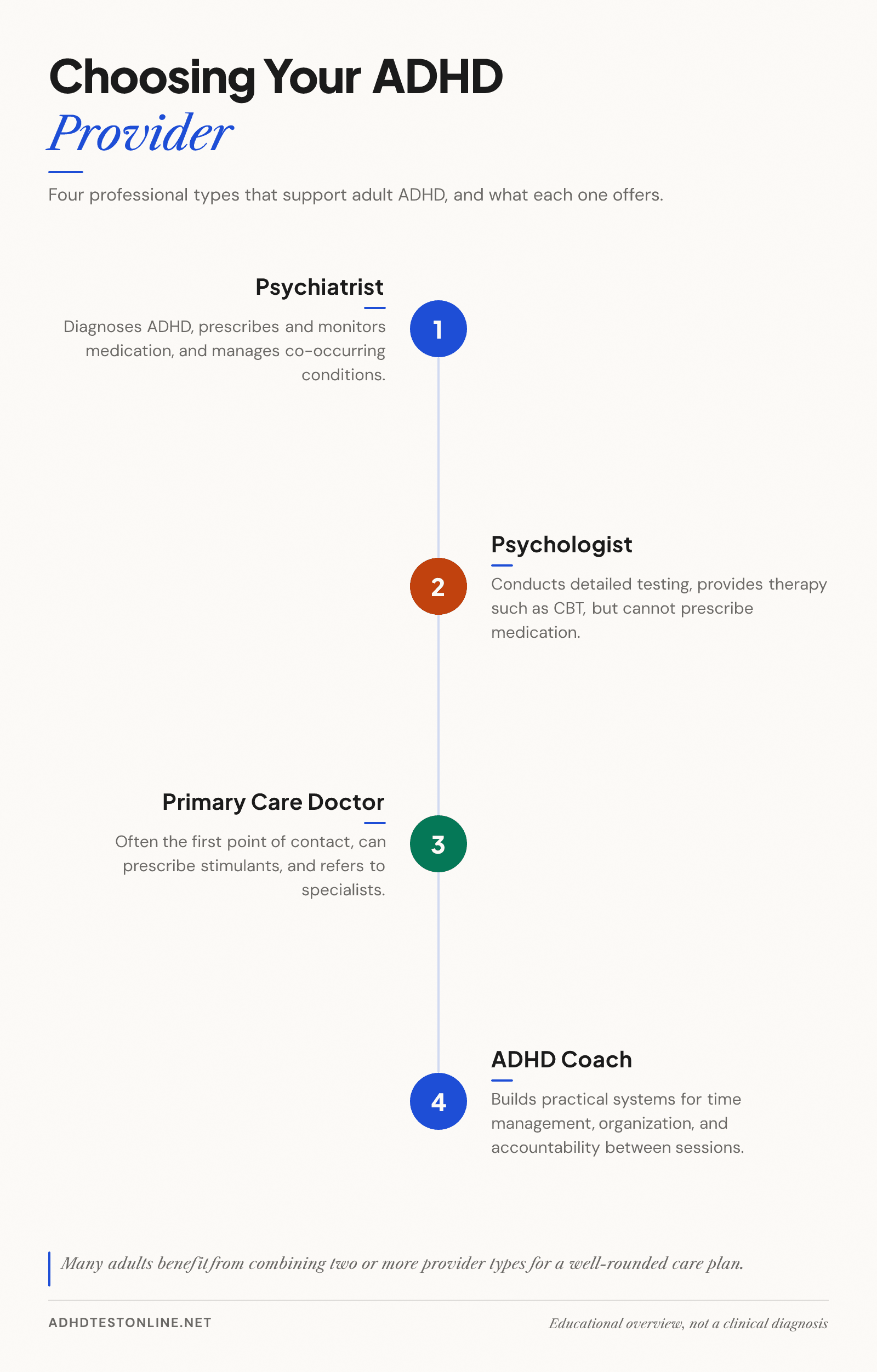
Getting professional help for ADHD as an adult usually starts with a conversation with your GP or primary care provider, who can screen for symptoms, rule out other causes, and refer you to a specialist. Many adults delay this step because they are unsure which type of provider to see.
Which professionals diagnose and treat adult ADHD?
Psychiatrists can prescribe medication, while psychologists and therapists focus on behavioral strategies and coping skills.
Several types of clinicians can help with adult ADHD, but each one plays a different role. Psychiatrists diagnose and prescribe medication. Psychologists diagnose and provide therapy but usually cannot prescribe. Your GP can screen, refer, and sometimes start treatment. Knowing who does what prevents wasted appointments and unnecessary delays. CHADD has published plain-language updates on how adult ADHD clinical practice guidelines are evolving in the United States, which can help you ask better questions in a first appointment (CHADD) [8].
Psychiatrists are medical doctors who specialize in mental health. They can conduct a full diagnostic assessment, prescribe stimulant and non-stimulant medications, and monitor treatment over time. For adults who suspect they may need medication, a psychiatrist is often the most direct path. In the UK, an NHS psychiatrist or specialist ADHD service handles formal diagnosis after a GP referral (NHS, ADHD in adults).
Psychologists (clinical or neuropsychologists) conduct detailed assessments that may include cognitive testing, structured interviews, and standardized rating scales. They provide therapy, including cognitive behavioral therapy adapted for ADHD. In most US states, Canada, and the UK, psychologists cannot prescribe medication, though a few US states and some military settings are exceptions.
Primary care providers (GPs) are often the best starting point. A 2019 systematic review found that many barriers to ADHD recognition exist in primary care, including misconceptions and limited training, but also noted that GPs remain the most accessible entry point for most adults (French et al., 2019) [1]. A GP who is comfortable with ADHD can screen you, initiate a referral, and in some cases begin medication while you wait for a specialist.
ADHD coaches are not clinicians and cannot diagnose or prescribe. They help with practical strategies: time management, organization, accountability. Coaching works best alongside clinical treatment, not as a replacement for it.
Nurse practitioners and physician assistants can diagnose and prescribe in many US states and Canadian provinces, often with shorter wait times than psychiatrists.
Provider comparison table
Provider
Can diagnose?
Can prescribe?
Can provide therapy?
Typical wait (varies widely)
Psychiatrist
Yes
Yes
Sometimes
Weeks to months
Psychologist
Yes
Rarely
Yes
Weeks to months
GP / Primary care
Can screen and refer; some diagnose
Yes (if trained)
No
Days to weeks
Nurse practitioner
Yes (in many jurisdictions)
Yes
Sometimes
Days to weeks
ADHD coach
No
No
No (skills-based support)
Days to weeks
For a deeper look at what the diagnostic process involves, see our guide on ADHD diagnosis for adults.
How do you find the right ADHD provider?
Finding a provider who understands adult ADHD takes some research, but a few strategies make it faster. Start with your GP for a referral, check your insurance directory for specialists listing ADHD as a focus area, and ask directly whether the provider has experience assessing adults rather than only children.
Ask your GP for a referral. In the UK, this is the standard pathway: your GP refers you to an NHS specialist ADHD service or a psychiatrist (NHS). In the US, Canada, and Australia, a GP referral is not always required by insurance, but it can help you reach the right specialist faster. In Australia, a GP referral is needed for Medicare-covered psychiatrist visits.
Use professional directories. In the US, Psychology Today's directory, the CHADD resource directory, and your insurance company's provider search all allow filtering by specialty. In Canada, provincial psychology associations maintain referral lists. In the UK, the AADD-UK and ADHD Foundation websites list private and NHS providers.
Screen the provider before booking. Call the office and ask:
Do you regularly assess adults for ADHD, or primarily children?
What does your assessment process include (structured interview, rating scales, collateral information)?
How long is a typical evaluation appointment?
Do you also assess for co-occurring conditions like anxiety and depression?
A provider who answers these questions clearly and specifically is more likely to give you a thorough assessment. One who seems vague about adult ADHD or only mentions children may not be the right fit.
Consider university training clinics. Many university psychology programs offer ADHD assessments at reduced cost, conducted by supervised graduate students using the same standardized tools as private practices.
What should you expect at your first appointment?
Writing down your symptoms, questions, and medication history before your first visit helps you stay focused during the appointment.
Your first ADHD appointment is primarily an information-gathering session. The clinician will ask about your current symptoms, your childhood history, how difficulties show up across work, home, and relationships, and whether other conditions might explain or overlap with your symptoms. A thorough evaluation typically takes 60 to 90 minutes, sometimes split across two visits.
There is no single test for ADHD. The CDC states that diagnosis involves several steps, including ruling out other conditions with similar symptoms such as sleep disorders, anxiety, and depression (CDC, Diagnosing ADHD) [2]. Most clinicians use a combination of structured clinical interviews, self-report rating scales (like the ASRS, or Adult ADHD Self-Report Scale), and sometimes collateral information from a partner, family member, or old school records.
Before you go, if you want a sense of where your symptoms fall, you can take a free ADHD screening to organize your thoughts and bring specific examples to the conversation.
First appointment preparation checklist
Use this checklist to make the most of your evaluation:
Write down 3-5 specific examples of how attention, organization, or impulsivity problems affect your daily life right now
Note any childhood difficulties: school reports, comments from parents or teachers, patterns you remember
List all current medications, supplements, and any substances you use regularly
Write down your sleep patterns, including how long it takes you to fall asleep and how rested you feel
Bring any previous mental health records or diagnoses (anxiety, depression, learning disabilities)
Prepare questions for the clinician (see the Q&A box below)
If possible, ask a partner, parent, or close friend to write a brief note about patterns they have noticed
Questions to ask your clinician
Question
Why it matters
What does your assessment process involve?
Helps you gauge thoroughness; a 10-minute checklist is not enough
Will you assess for co-occurring conditions?
ADHD rarely occurs alone; anxiety, depression, and sleep problems are common (NIMH)
What treatment options would you consider?
Lets you understand whether the provider offers medication, therapy, or both
How will we measure whether treatment is working?
Sets expectations for follow-up and adjustment
Can I get a written summary of the evaluation?
Useful for workplace accommodations, insurance, or future providers
Is telehealth a good option for ADHD assessment?
Telehealth ADHD assessments are widely available and can be as thorough as in-person visits when the provider uses structured interviews and validated rating scales. For many adults, telehealth removes barriers like travel time, childcare, and the difficulty of taking time off work. It is especially useful in rural areas or regions with long specialist waitlists.
In the US, most major insurance plans now cover telehealth mental health visits, though coverage rules changed frequently during and after the COVID-19 pandemic. Check with your insurer before booking. In the UK, some private ADHD clinics offer remote assessments, but NHS pathways typically require at least one in-person appointment. In Canada and Australia, telehealth coverage varies by province or territory.
What telehealth works well for:
Initial screening and structured diagnostic interviews
Follow-up medication management appointments
Therapy sessions (CBT for ADHD)
Coaching sessions
What may still require in-person visits:
Neuropsychological testing with timed tasks
Physical examination or ECG if required before starting certain medications
Situations where the clinician needs to observe behavior in a controlled setting
When choosing a telehealth provider, apply the same screening questions you would use for an in-person clinician. A video call does not change the standard of care; the assessment should still take adequate time and cover your full history.
How do you handle cost and insurance for ADHD care?
ADHD assessment and treatment costs vary widely depending on your country, insurance status, and provider type. In the US, a comprehensive evaluation can range from a few hundred to several thousand dollars without insurance. In the UK, NHS assessments are free but waitlists can stretch to months or longer. Knowing your options in advance prevents surprises.
In the US:
Most private insurance plans cover psychiatric and psychological evaluations when ADHD is suspected. Call your insurer and ask whether they cover "diagnostic evaluation for ADHD" and which provider types are in-network.
If you are uninsured, community mental health centers often offer sliding-scale fees. University training clinics are another lower-cost option.
Some employers' Employee Assistance Programs (EAPs) provide a limited number of free mental health sessions that can include initial ADHD screening.
In the UK:
The NHS covers ADHD assessment and treatment at no cost, but waiting times for adult ADHD services vary significantly by region. Your GP initiates the referral (NHS).
Private assessments in the UK typically cost several hundred pounds. Some private diagnoses can be accepted by the NHS for ongoing prescribing under shared care agreements, though this is not guaranteed.
In Canada:
Psychiatrist visits are covered by provincial health insurance. Psychologist assessments are not universally covered but may be partially covered by extended health benefits through an employer.
In Australia:
Medicare covers psychiatrist visits with a GP referral. Psychologist sessions may be partially covered under a Mental Health Treatment Plan (up to a set number of sessions per year).
"If you are concerned about whether you have ADHD, the first step is to talk with a healthcare provider to find out if the symptoms fit an ADHD diagnosis."
CDC, 2024 [3]
How can you advocate for yourself during the process?
Self-advocacy is the skill that makes the biggest practical difference in the quality of ADHD care you receive. It means clearly communicating your symptoms, asking questions when something is unclear, and pushing back respectfully when you feel dismissed. Many adults with ADHD have spent years being told their difficulties are laziness or anxiety, which can make self-advocacy feel uncomfortable.
Be specific about your symptoms. Instead of saying "I can't focus," describe the pattern: "I lose track of conversations midway through, I miss deadlines even when I care about the work, and I have to re-read the same paragraph multiple times." Specific examples help clinicians distinguish ADHD from other conditions.
Bring documentation. Written notes, old report cards, performance reviews, or a partner's observations give the clinician data beyond your self-report. ADHD symptoms must have been present since childhood for a diagnosis, so any evidence from earlier in life is valuable (CDC, ADHD across the lifetime).
Ask for a written treatment plan. A good treatment plan includes the diagnosis, recommended interventions (medication, therapy, coaching, or a combination), follow-up schedule, and criteria for measuring improvement. Having this in writing helps you track progress and is useful if you change providers.
Request a second opinion if something feels wrong. If a provider dismisses your concerns after a brief conversation, or diagnoses you without a thorough history, you have every right to seek another evaluation. ADHD in adults responds well to integrated treatment when properly identified (Geffen & Forster, 2018).
Know your workplace rights. In the US, ADHD can qualify as a disability under the ADA when it substantially limits one or more major life activities. In the UK, the Equality Act 2010 applies when ADHD has a substantial, long-term adverse effect on day-to-day activities. In both cases, you may be entitled to reasonable workplace accommodations. The CDC notes that people with ADHD can request workplace accommodations from their employer (CDC).
If you are still in the early stages of figuring out whether ADHD might explain your difficulties, you can start with our online ADHD self-test to organize your observations before approaching a provider.
What are the red flags in an ADHD provider?
Not every provider who offers ADHD services delivers quality care. Recognizing red flags early saves you time, money, and the frustration of a missed or incorrect diagnosis. A thorough adult ADHD evaluation requires time, clinical skill, and attention to your full history.
Watch for these warning signs:
Diagnosis in under 15 minutes. A proper assessment involves a detailed history, symptom rating scales, and consideration of other conditions. A provider who diagnoses or rules out ADHD after a brief conversation is cutting corners.
No questions about childhood. ADHD is a neurodevelopmental condition. Symptoms must have been present before age 12 for a DSM-5 diagnosis. A provider who only asks about current symptoms is missing a required diagnostic criterion (CDC, Diagnosing ADHD).
Ignoring co-occurring conditions. ADHD commonly co-occurs with anxiety, depression, and sleep problems (NIMH). A provider who does not ask about these may miss conditions that need separate treatment or that could explain your symptoms instead.
Guaranteeing specific outcomes. No ethical clinician guarantees that medication will solve your problems. Treatment is a process of finding what works for you, and individual responses vary.
Pressure to commit to expensive packages upfront. Some private clinics require large upfront payments for bundled services before you have even been assessed. A reputable provider bills per session or per evaluation.
Dismissing your concerns without explanation. If a provider says "you don't have ADHD" without explaining their reasoning or what they think is going on instead, that is not a thorough evaluation.
Decision framework: when to seek a second opinion
Consider seeking another provider if:
The evaluation lasted less than 30 minutes total
You were not asked about childhood symptoms or functioning
Co-occurring conditions were not discussed
You were given a diagnosis but no treatment plan
The provider seemed unfamiliar with adult ADHD presentation
Infographic: key points about getting professional adhd help adults.Each provider type fills a different role in adult ADHD care, and many people benefit from working with more than one.
Frequently asked questions
Do I need a referral to see an ADHD specialist?
It depends on your country and insurance. In the UK, a GP referral is required for NHS ADHD services (NHS). In the US, many insurance plans allow self-referral to a psychiatrist or psychologist, though some HMO plans require a primary care referral. In Australia, a GP referral is needed for Medicare-covered psychiatrist visits. Check with your insurer before booking.
How long does an ADHD assessment take?
A thorough adult ADHD assessment typically takes 60 to 90 minutes, sometimes spread across two sessions. It includes a structured clinical interview, self-report rating scales, and questions about childhood history. Assessments that take less than 30 minutes may not be comprehensive enough to distinguish ADHD from conditions with overlapping symptoms (CDC).
Can my GP diagnose ADHD, or do I need a specialist?
In many countries, GPs can screen for ADHD and initiate referrals. Some GPs with additional training can diagnose and begin treatment. In the UK, formal diagnosis is typically made by a specialist after a GP referral. In the US, some primary care providers diagnose and prescribe for ADHD, particularly in areas with limited specialist access.
What if I cannot afford an ADHD assessment?
Several options can reduce cost. In the US, community mental health centers offer sliding-scale fees, and university training clinics provide assessments at reduced rates. In the UK, NHS assessments are free, though waitlists can be long. In Canada, psychiatrist visits are covered by provincial health insurance. In Australia, Medicare covers psychiatrist visits with a GP referral.
Is an online ADHD assessment legitimate?
Telehealth ADHD assessments can be legitimate when conducted by a licensed clinician using structured interviews and validated tools. The key is the provider's qualifications and process, not the medium. A thorough video assessment is better than a rushed in-person one. Be cautious of services that diagnose based solely on a brief questionnaire without a clinical interview.
What should I bring to my first ADHD appointment?
Bring specific examples of how symptoms affect your daily life, any childhood records (report cards, previous evaluations), a list of current medications and supplements, and notes about your sleep patterns. If possible, ask someone who knows you well to write a brief description of patterns they have noticed. Written preparation helps you communicate clearly during the appointment.
Can I be diagnosed with ADHD if I was not diagnosed as a child?
Yes. Many adults with ADHD were never identified in childhood, particularly women and people with primarily inattentive symptoms. The diagnostic requirement is that symptoms were present before age 12, not that they were formally recognized. A clinician will ask about your childhood functioning to establish this history (CDC).
How do I know if my provider is a good fit?
A good ADHD provider takes a thorough history, asks about childhood and current functioning across multiple life areas, screens for co-occurring conditions, explains their reasoning, and collaborates with you on a treatment plan. If you feel dismissed, rushed, or confused after an appointment, those are signals to consider a different provider.
What happens after I receive an ADHD diagnosis?
After diagnosis, your clinician should discuss treatment options, which may include medication, therapy (often CBT adapted for ADHD), coaching, or a combination. Clinical evidence suggests that integrated approaches combining pharmacological and psychotherapeutic interventions can be effective for many adults (Geffen & Forster, 2018). You should receive a written treatment plan with follow-up appointments scheduled.
Are ADHD medications safe for adults?
Stimulant and non-stimulant medications for ADHD have been studied extensively and are considered first-line treatments in clinical guidelines (NICE NG87). Like all medications, they carry potential side effects, and individual responses vary. Your prescribing clinician should monitor you regularly, especially during the first months, and adjust the treatment plan based on your response.
How long are ADHD specialist waitlists?
Waitlists vary dramatically by region. In the UK, NHS adult ADHD services can have waits of several months to over a year in some areas. In the US, psychiatrist availability depends on location and insurance network. Strategies to reduce wait time include asking to be placed on a cancellation list, considering telehealth providers in other regions (where allowed), and starting with a GP who can begin the process while you wait for a specialist.
Researched and written by Sarah Chen, Health Writer, ADHD Education, using 8 published sources listed above. For how we research and fact-check, read our editorial policy. This article is educational and is not medical advice; for a diagnosis or treatment plan, see a licensed clinician.
Sarah writes about ADHD screening, clinical evaluations, and what happens between taking an online questionnaire and sitting across from a clinician. Most of her work turns published guidelines into steps you can actually follow.